
Geographical reviews: The Atlas of Finland
- Publication
- Geographical Review
- Volume
- 20
- Issue
- 2
- Pages
- 350-351
Finland · Version 3
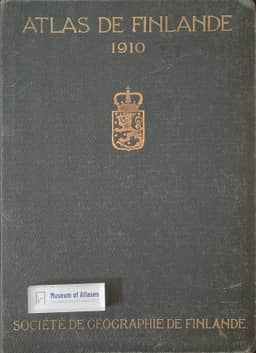
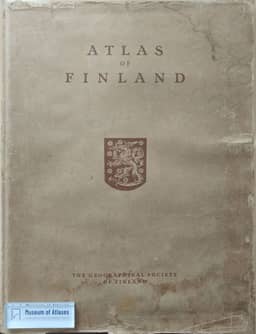
1925A review of the 1925 Atlas of Finland treats the work as a whole: the atlas itself carries explanatory matter in Finnish, English and Swedish, with a separate text volume, and it replaces the 1910 French edition. The reviewers praise the four-sheet 1:1,000,000 political map, the revised 1:2,000,000 bathy-orographical, geological and surface-deposit maps, and especially the four-sheet vegetation and population map, whose seven-color detail they call admirable; they also find the small regional maps, foreign-trade maps and numerous topical maps useful. Changes from 1910 include moving statistical tables to the text volume, adding an index and trilingual contents, and increasing the total number of maps while reducing page count and map sizes. Criticism concerns English translation errors that should have been caught by native speakers, the preference for block shading over the dot method, lower paper quality, and less clean color and type register.
View whole-article summary
The review assesses the Geographical Society of Finland’s Atlas of Finland, dated 1925 because most of its statistics refer to that year, against its 1899 and 1910 predecessors. It reports that an English edition replaces the French 1910 edition; map explanations appear in Finnish, English, and Swedish, with a separate single-language text volume. Articles by subject-map editors and responsible bureau heads explain the maps’ sources and interpret their contents. The reviewer particularly praises the detailed vegetation and population map and the data assembled for it, notes the regional maps’ potentially controversial approaches to defining regions, and describes trade maps showing values per inhabitant of trading countries. Numerous maps cover public services and economic and social activities. Compared with 1910, statistical tables move to the text, an index is added, and smaller maps allow a greater map count on fewer pages without, in the reviewer’s judgment, reducing usefulness. The review praises the atlas overall while criticizing avoidable English translation errors, the predominance of block shading over dots in distribution maps, and poorer paper that weakens the clarity of color and type.
Related Atlases
Comments
Loading...
0/2000