
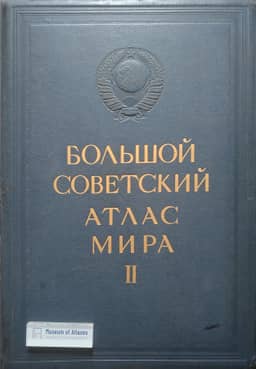
About the Maps of Volume II of the BSAM
О картах II тома БСАМ
- Publication
- Геодезист
- Issue
- 4
- Pages
- 23-26
Great Soviet Atlas of the World · Version 1
1937–1939M. A. Sergeev reviews the representation of the Soviet North in volume II of the Great Soviet World Atlas. He praises the general and regional maps for clearly showing the distribution of population, industry, hunting and fishing activities, agriculture, transport, and trade, and for distinguishing industrial development from other northern livelihoods. Examples from Krasnoyarsk, Arkhangelsk, Omsk, and the Far East demonstrate how inset and supplementary maps make complex economic patterns legible. His criticisms include misplaced settlements, weaknesses in the depiction of Yakutia’s population density, the conflation of fishing and marine-mammal hunting in the pre-revolutionary inset, and omissions affecting reindeer husbandry and several industries. Sergeev considers the maps exceptionally useful for teaching and economic research, crediting their current, checked information to painstaking work with unpublished departmental records in a field with few economic publications.
View whole-article summary
This article reviews the maps of the Soviet North included in Volume II of the Great Soviet Atlas. The author first analyzes the general maps of the USSR, the RSFSR, and the North's economy, noting their strengths in depicting administrative divisions, population density, and economic indicators, while also pointing out specific errors and omissions. The discussion then shifts to regional maps, which are praised for effectively illustrating the economic profiles, industrial structures, and key nodes of various administrative units. The article particularly commends the editorial use of inset maps to enhance clarity and readability. In conclusion, the author asserts that Volume II provides an accurate, up-to-date, and comprehensive cartographic representation of Soviet economic development in the North, making it an invaluable resource for both educational and research purposes, a result of meticulous work with primary sources.
Related Atlases
Comments
Loading...
0/2000