
National and Regional Atlases as an Expression of National/Regional Identities: New Examples from Post-Communist Europe
- Publication
- The Cartographic Journal
- Volume
- 41
- Issue
- 2
- Pages
- 150-166
Romania · Version 3
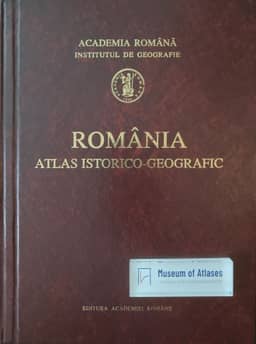
1996Peter Jordan interprets the 1996 Romania: Historical-Geographical Atlas as a post-Communist update and supplement to the Romanian Academy’s 1970 atlas that largely reasserts traditional national narratives. He highlights its extensive historical section, which traces Romanian origins to Roman Dacia and intermarriage between Dacians and Roman soldiers. He criticizes the map of ethnic composition based on the 1992 census for assigning nearly identical colours to Romanians and the 1.6 million Hungarians, making the Hungarian population’s distribution difficult to discern. Jordan reads this design as evidence of the nation-state ideology prevailing when the atlas was prepared and published.
View whole-article summary
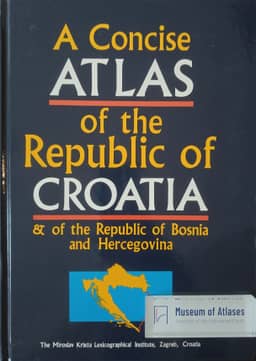
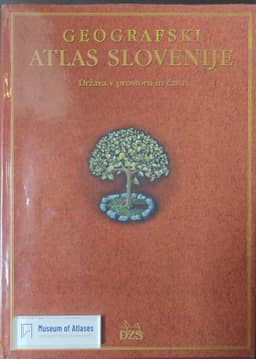
The article compares four national and regional atlases from post-communist Europe, examining how maps, images, and texts articulate national or regional identities. The National Atlas of Slovenia presents the country as an equal member of the international community, the centre of a nation extending beyond state borders, an old and early-industrialized cultural region, and a diverse landscape closely associated with the Alps. The 1993 concise atlas of Croatia and Bosnia and Herzegovina, intended for foreign audiences, invokes historical borders, institutional continuity, Croats abroad, and dialect geography to define Croatian statehood and cultural space; its classification of Štokavian reflects the contemporary Croatian–Serbian antagonism. The Atlas of Lower and Opole Silesia incorporates the region’s Polish, Bohemian, Habsburg, Prussian, and German pasts and documents post-1945 population exchange, constructing Silesian identity from multiple historical traditions, economic centrality, and its position at a Central European crossroads. Romania’s historical-geographical atlas reiterates the traditional narrative of national origins in Roman Dacia. Its use of nearly identical colours for Romanians and Hungarians obscures the latter’s spatial distribution, which the author interprets as evidence of the nation-state ideology prevailing in Romania during the 1990s.
Comments
Loading...
0/2000