
The fifth edition of the atlas of Finland: Thematic and methodological guidelines
- Publication
- GeoJournal
- Volume
- 21
- Issue
- 3
- Pages
- 289-299
Finland · Version 5
1977–1994Editorial chairman Stig Jaatinen describes the fifth edition of the Atlas of Finland, planned from 1971, with compilation beginning in 1974 and the first folio, Forestry, appearing in 1977. Its planned 26 thematic folios were organized around physical environment; population, economy and communications; and society, culture and living conditions. Joint publication by the Geographical Society of Finland and the National Survey depended on state support, a small editorial staff and extensive institutional cooperation. Production shifted from manual techniques to automation, including Thematic FINGIS. Jaatinen emphasizes geographical analysis and synthesis, careful thematic classifications and independent editorial scrutiny of largely existing data. Examples include multiscale presentation of Quaternary deposits in Geology, regular diagram scales for comparing fish catches, and coordinated colours in Forestry and Biogeography, Nature Conservation. He also identifies publication delays, uneven detail, overloaded graphics, translation and text–image coordination problems, and reduced methodological coherence across numerous contributors. He judges the edition a strong foundation for regional information on Finland while insisting that technological development requires a coherent geographical philosophy.
View whole-article summary
The first edition of Atlas of Finland was published in 1899, and since then four more editions have appeared, the fifth started in 1977. The two first editions (the second appeared in 1910) were published in order to define the identity of the nation during a time of Russian political opression and a nationalistic awakening. During the same period, in 1901 J. Gebhard published a social-statistical atlas of Finland, likewise a work of scholarly pioneering. The third edition of Atlas of Finland appeared in 1925, here the geographical analysis was much enhanced thanks to the editorial work of J.G. Granö. At this time Finland was still predominately an agrarian state, however, when the forth edition of the Finnish national atlas was published in 1960, the wind of change had set in. Prof. Leo Aario was the leader of this edition, where the deep changes after WW II were documentated,3also the beginning of the rapi d industrialization of the country.
Related Atlases
Atlas of Finland, Folio 234: Forestry
Finland · 1977
Atlas of Finland, Folio 312-313: Planning, Security
Finland · 1991
Atlas of Finland, Folio 242-244: Construction, Energy
Finland · 1986
Atlas of Finland, Folio 210: Population
Finland · 1981
Atlas of Finland, Folio 220: Economic Activity
Finland · 1992
Atlas of Finland, Folio 311: Public Administration
Finland · 1978
Atlas of Finland, Folio 151-152: Land Use, Land Ownership, Real Estate Formation
Finland · 1991
Atlas of Finland, Folio 241: Industry
Finland · 1983
Atlas of Finland, Folio 321-323: Organizations and Civic Activities
Finland · 1991
Atlas of Finland, Folio 232-233: Agriculture - Special Branches, Fisheries
Finland · 1980
Atlas of Finland, Folio 251-253: Commerce, Services
Finland · 1990
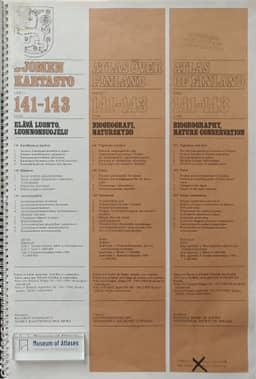
Atlas of Finland, Folio 141-143: Biogeography, Nature Conservation
Finland · 1989
Atlas of Finland, Folio 160: State and Care of the Environment
Finland · 1992
Atlas of Finland, Folio 341-344: Living Conditions and Social Policy
Finland · 1984
Atlas of Finland, Folio 132: Water
Finland · 1986
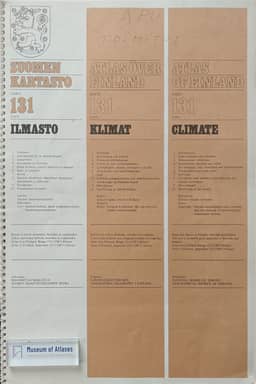
Atlas of Finland, Folio 131: Climate
Finland · 1987
Atlas of Finland, Folio 330: Education, Research, Information, Culture
Finland · 1989
Atlas of Finland, Folio 231: Farming
Finland · 1992
Atlas of Finland, Folio 261-263: Communications, Tourism
Finland · 1985
Atlas of Finland, Folio 112: Mapping of Finland
Finland · 1984
Atlas of Finland, Folio 121-122: Relief and Landforms
Finland · 1986
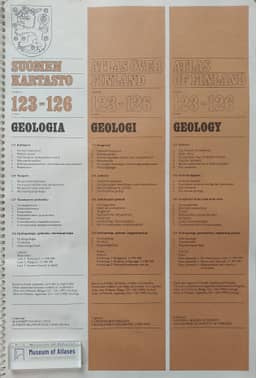
Atlas of Finland, Folio 123-126: Geology
Finland · 1990
Comments
Loading...
0/2000