
On the new national atlas of the Armenian SSR
О новом национальном атласе Армянской ССР
- Publication
- Известия Академии Наук Армянской ССР. Науки о Земле
- Volume
- 41
- Issue
- 1
- Pages
- 71-73
Armenia · Version 1
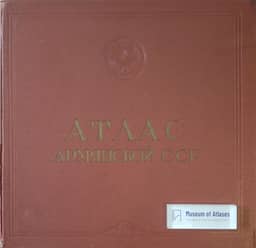
1961In their account of a planned successor, A. B. Bagdasaryan, A. A. Bagdasaryan and T. A. Trifonova describe the 1961 Atlas of the Armenian SSR as a substantial cartographic synthesis of contemporary knowledge about the republic, noting its section on the history of the Armenian people. They report that it was presented at the XX International Geographical Congress in London and received recognition domestically and abroad. They credit its rich content, integrated coverage and expressive maps with supporting the republic’s economic activities for more than a quarter-century. A comparison table records the 1961 atlas’s natural-environment coverage, including 20 climate maps, eight geological maps and seven hydrological maps.
View whole-article summary
This article discusses the compilation of a new national atlas for the Armenian Soviet Socialist Republic. It begins by reviewing the historical significance and limitations of the first 'Atlas of the Armenian SSR' published in 1961, highlighting the necessity for a second-generation comprehensive national atlas in the context of rapid scientific and technological progress and intensified society-nature interactions. The paper details the program for the first volume (Natural Conditions) of the new atlas, developed by the Geography Department of the Institute of Geological Sciences, covering its structure, content, new sections (e.g., geophysics, geomorphology, ecological assessment), and methodological innovations like the use of remote sensing. By comparing the structure and content of the old and new atlases, the article emphasizes the new atlas's value in reflecting environmental dynamics and supporting ecological protection and rational resource use, aiming to provide a more comprehensive and scientific basis for research, planning, and economic development.
Comments
Loading...
0/2000