
Forum: Reviews and Comments: National Atlas of Georgia
- Publication
- Erdkunde
- Volume
- 72
- Issue
- 4
- Pages
- 329-330
Georgia · Version 2
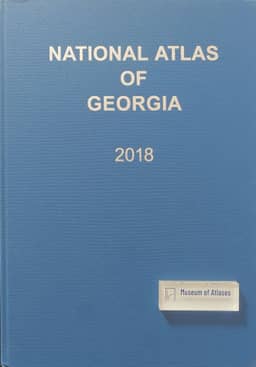
2012–2018This review examines the 2018 English National Atlas of Georgia, a comprehensive revision of the 2012 Georgian edition produced through cooperation between geography institutes in Tbilisi and Giessen. It describes extensive physical-geographical coverage alongside population, economy, religion and historical maps, with demographic information incorporating the 2014 census and updates to 2016. The reviewer particularly values the soil legend’s pairing of traditional Russian-derived and international terminology and the maps documenting natural hazards, endemic species and population decline. Socio-economic coverage is limited by the availability of published regional data; Abkhazia and South Ossetia are largely excluded from these maps, while a map of the secession areas and internally displaced persons addresses their political context. Suggested improvements include additional socio-economic and historical maps, fuller city-map labels and an updated agricultural map inherited largely unchanged from 1964. The reviewer also identifies unexplained scoring and missing data reference dates, but judges these shortcomings minor in relation to the atlas’s cartographic and editorial quality and considers its price reasonable.
View whole-article summary
This article reviews two geographical publications. The first review assesses the National Atlas of Georgia (2018 English edition), a collaborative effort between Georgian and German scholars that comprehensively revises the 2012 Georgian-language edition with new maps and thematic additions. The atlas systematically presents Georgia's physical geography (geology, geomorphology, climate, hydrology, soils, vegetation) and human geography (population, religion, agriculture, tourism, historical development), while carefully addressing the politically sensitive status of Abkhazia and South Ossetia. The review notes limitations in socio-economic map coverage and data timeliness but praises the atlas as an impressive cartographic achievement. The second review examines the Routledge Handbook of Asian Borderlands (2018), which contains 35 contributions across seven sections, exploring paradigm shifts in borderland studies through themes such as violence, gender, mobility, and livelihoods. The handbook moves beyond traditional legal and political frameworks to conceptualize borders as dynamic social spaces, reflecting contemporary academic trends. The review considers it a valuable contribution to border studies.
Related Atlases
Comments
Loading...
0/2000